
I spent the first six years of my career specifying chromatography systems by reading brochures, and the next fifteen learning why that was a bad idea. The instrument that looked best on a spec sheet was often the one that clogged first, leaked at the pump seal, or forced a method revalidation when the vendor changed a column fitting. This guide is what I wish someone had handed me: a practical buyer’s and operator’s framework built around real numbers, real failure modes, and the questions that actually decide whether a system survives its first year in your lab.
Most bad purchases start with a capability instead of a requirement. A lab manager sees a 1290 Infinity II with a 1200-bar pump and decides it belongs in the method development group, then discovers nobody has a method that needs more than 400 bar. The pressure ceiling you pay for is the pressure ceiling you must justify. Before you open a single quote, write down four things.
- Analyte chemistry: molecular weight, polarity, pKa, volatility, thermal stability, and UV chromophores. A 300 Da neutral compound and a 12 kDa peptide are different purchasing decisions.
- Concentration range: the lowest and highest expected level in the same run. A method that must see 0.5 ppb and 500 ppm simultaneously usually needs a detector change, not a column change.
- Throughput: samples per day, not samples per year. A 40-sample batch on a Monday is a different problem from 400 samples spread across five days.
- Regulatory frame: whether the data must survive an audit under 21 CFR Part 11, USP <621>, or an EPA SW-846 method. That single answer can add $15,000 to $40,000 to a system’s price through software and qualification.
If you can answer those four in a paragraph, the shortlist writes itself. If you cannot, no vendor can help you, because every sales engineer will simply sell you the top of their range.
The four separation modes and when each one wins
Reversed-phase HPLC: the default for a reason
Roughly 70 to 80 percent of small-molecule work in a typical pharma or environmental lab is reversed-phase. A C18 column, water and acetonitrile or methanol, UV detection at 210 to 280 nm. It is forgiving, well documented, and cheap to replace. The workhorse format is 4.6 × 150 mm, 5 µm for conventional HPLC, or 2.1 × 100 mm, 1.8 µm for UHPLC. Expect backpressures around 80 to 150 bar at 1.0 mL/min on the 4.6 mm format and 400 to 800 bar on the 2.1 mm sub-2 µm format at 0.4 mL/min.
The trap is buying UHPLC because it is faster. A 1.8 µm column at 600 bar will absolutely deliver a 90-second separation. It will also punish you for every unfiltered sample, every slightly worn pump seal, and every mobile phase that was not degassed. If your sample prep is manual and your buffers are made on a bench, a 400-bar conventional system with a 3 µm column often gives you 80 percent of the speed with 20 percent of the maintenance grief.
Normal-phase and HILIC: for the polar compounds reversed-phase cannot retain
When your analyte elutes at the solvent front on C18, you have a retention problem, not a column problem. HILIC with an amide or zwitterionic stationary phase retains sugars, small polar amines, and metabolites that reversed-phase ignores. The catch is equilibration: HILIC needs 20 to 30 column volumes of high-organic mobile phase before the baseline stabilizes, which on a 100 × 2.1 mm column is 6 to 10 minutes of dead time per method switch. Budget for it or your retention times will drift all afternoon.
Ion chromatography: when the analyte is an ion
Anions and cations in water, brines, and process streams belong on IC, not HPLC with an ion-pair reagent. Suppressor-based IC with a conductivity detector routinely hits low ppb detection limits for chloride, sulfate, nitrate, and phosphate. The consumable cost lives in the suppressor and the guard column, and the suppressor has a finite life (typically 6 to 12 months depending on eluent and sample load). If you run 200 samples a week, price the suppressor into your annual budget before you sign.
Gas chromatography: volatiles, solvents, and residual monomers
GC with a flame ionization detector (FID) or mass spectrometer (MS) handles anything with a boiling point under roughly 350 °C and adequate thermal stability. A 30 m × 0.25 mm × 0.25 µm 5% phenyl polysiloxane column is the reference choice for semivolatile environmental work and residual solvent testing. The inlet is where most GC problems live: a split/splitless liner fouls after 100 to 300 injections depending on matrix, and a dirty liner produces peak tailing and ghost peaks that look exactly like a failing column. Change the liner first. It costs $15 and takes four minutes.
Detector selection: the decision most buyers get backwards
People agonize over the pump and treat the detector as an afterthought. In my experience the detector determines whether the method is even possible. Here is the honest comparison.
| Detector | Typical LOD | Selectivity | Best fit | Main nuisance |
|---|---|---|---|---|
| UV/DAD | 1 to 10 ng on column | Low (chromophore required) | Small molecules with aromatic or carbonyl groups | Baseline drift with gradient and temperature |
| Fluorescence | 0.01 to 1 ng on column | High | Derivatized amines, aflatoxins, PAHs | Derivatization adds a step and variability |
| RI | 100 to 1000 ng on column | Very low | Sugars, polymers, compounds with no chromophore | Temperature sensitivity; cannot run gradients |
| Single quad MS | 0.1 to 5 ng on column | Medium (nominal mass) | Confirmation, unknown screening | Source cleaning every 2 to 6 weeks |
| Triple quad MS/MS | 0.001 to 0.1 ng on column | Very high (MRM) | Trace residues, regulated methods, ppb work | Capital cost, tuning, and matrix effects |
If your target is 10 ppb in a complex matrix, a UV detector will not get you there no matter how good the column is. Conversely, buying a triple quad for a 1 percent assay method wastes six figures and adds a tuning schedule you did not need. Match the detector to the required LOD, then work backward.
A concrete selection checklist
Use this as the gate before you request quotes. If a candidate system fails any line, cross it off rather than rationalizing it.
- Pressure rating vs. method: system maximum at least 1.5× the highest method backpressure. A 600-bar method on a 400-bar pump is a warranty conversation waiting to happen.
- Flow accuracy: ±1% or better at the working flow. Below 0.1 mL/min, confirm the pump can actually hold it; many cannot.
- Autosampler capacity: at least 1.5× your largest overnight batch, so you are not reloading at 2 a.m.
- Carryover: under 0.05% for regulated work. Ask for the vendor’s actual test data on a sticky compound, not a general claim.
- Column oven range: at least 5 °C above ambient to 60 °C for standard work; to 80 or 90 °C if you run ion-pair or high-temperature methods.
- Injection volume range: 0.1 to 100 µL covers nearly everything; confirm the loop or needle-pass design at the low end.
- Detector cell volume: under 2 µL for 2.1 mm columns, or you will lose resolution to extra-column band broadening.
- Software and audit trail: confirm 21 CFR Part 11 compliance and electronic signature support if regulated. Test the audit trail yourself.
- Service footprint: local field engineer within a day’s travel, and a published consumable price list. Ask for it in writing.
Consumables and sample prep: where the money and the failures live
I have watched labs spend $90,000 on an instrument and then destroy its performance with unfiltered samples and the wrong vials. Consumables are not an afterthought; they are the difference between a method that runs for a year and one that generates a service call every quarter.
Filtration is non-negotiable
Particulates are the number one cause of premature column death and injector blockage. Filter every sample through a 0.22 µm or 0.45 µm membrane before injection. For aqueous and general organic mobile phases, a HPLC filter with a nylon or PES membrane is the standard choice. For aggressive solvents, strong acids, and anything that would dissolve a cellulose acetate membrane, reach for a PTFE membrane filter; PTFE is chemically inert across nearly the full organic solvent range and rated to well above 100 °C. I keep both formats on the shelf and match the membrane to the mobile phase, not to whatever box is closest.
Filter diameter matters too. A 13 mm syringe filter holds less than 1 mL of holdup and suits small samples; a 25 mm or 33 mm filter handles 10 to 100 mL with far less backpressure. Using a 13 mm filter on a 50 mL mobile phase preparation is how you spend ten minutes pushing a plunger and contaminate the filtrate with the membrane’s extractables.
Vials, septa, and the small stuff that ruins runs
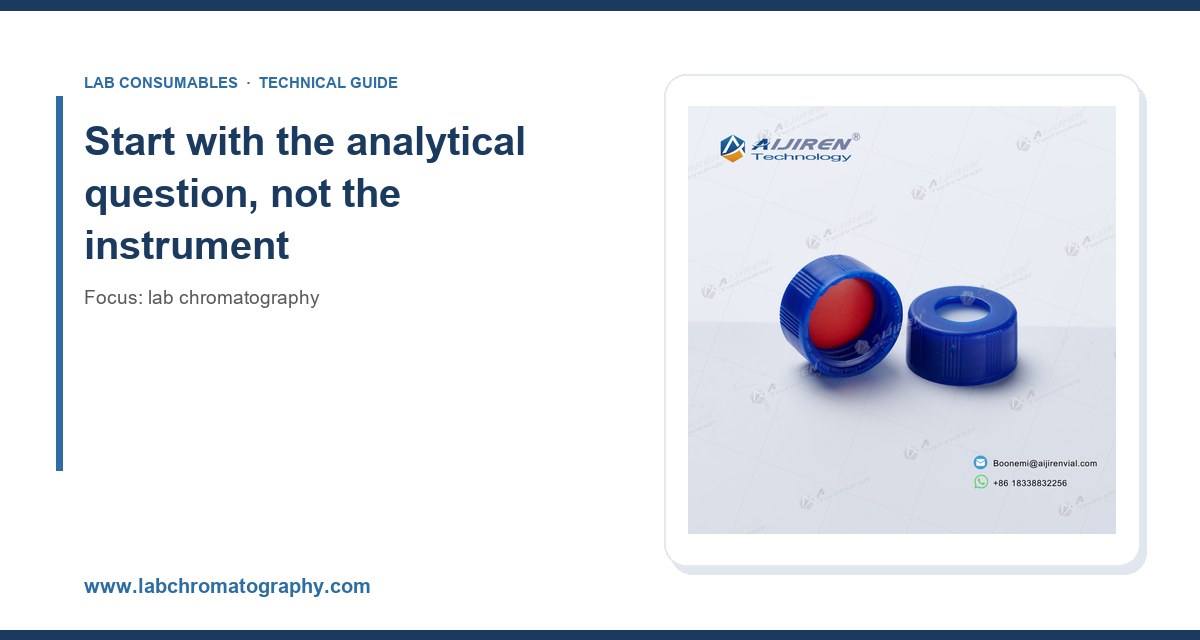
A 2 mL clear glass vial with a PTFE-lined silicone septum is the default autosampler vial. Two details get missed. First, septum choice: silicone alone will coring-shed particles into the vial after repeated needle punctures, so specify a PTFE-faced septum and replace caps after roughly 10 punctures on the same position. Second, fill volume: leave headspace, because a vial filled to the neck will overflow when the needle displaces liquid and contaminate the tray. For water and wastewater work, use a dedicated COD vial with the correct volume and closure for the digestion method; mixing COD vials with autosampler vials is a classic source of cross-contamination and bad blanks.
Columns and the reference price list
Columns are consumables, and the best vendors publish the numbers. Agilent’s GC columns and accessories catalog lists film thickness, temperature limits, and phase polarity for every part number, which is exactly what you need to compare. Thermo Fisher’s chromatography and sample handling portfolio covers the same ground across HPLC and GC consumables. Restek’s technical resources are worth bookmarking for their application notes and retention index data, which save hours when you are scouting a method for an unfamiliar compound class.
Column temperature limits are a hard stop, not a suggestion. A standard C18 is typically rated to 60 °C; push it to 80 °C and you accelerate stationary phase hydrolysis and lose retention. A 5% phenyl GC column is often rated to 325 to 350 °C; run it at its maximum continuously and the column bleeds and shortens its life. Respect the limits and buy a column rated for the temperature you actually need.
Operational precautions that prevent most failures
Mobile phase and degassing
Prepare mobile phase with HPLC-grade solvent and 0.22 µm filtered water. Degas by sparging with helium for 10 to 15 minutes or use an inline vacuum degasser. Air bubbles in the pump head cause check-valve failure and the classic “pressure at zero” alarm. Buffer pH is the other silent killer: keep phosphate buffers under pH 7.5 and acetate under pH 5.5, or you will precipitate salt in the pump and column. Rinse the system with 10 percent aqueous methanol at the end of the day if you ran buffer; never leave a buffer sitting in the lines overnight.
Leak checks and torque values
Finger-tight is not a torque specification. For stainless HPLC fittings, use a quarter-turn past finger-tight and no more; over-torquing deforms the ferrule and creates a leak you cannot find. For PEEK fingertight fittings, hand-tight is correct and a wrench will crack the nut. Check for leaks at every connection after a column change by running at your working pressure for 2 minutes and watching for weeping at the ferrules. A slow leak at 400 bar will show up as a drifting baseline within an hour.
System suitability before every batch
Run a suitability standard and check retention time RSD under 1% across six injections, peak area RSD under 2%, and resolution of at least 1.5 between critical pairs. If any of those fail, stop and fix the system before you inject samples. A batch run on a system with 3% area RSD is a batch you will repeat.
Troubleshooting checklist
When a method misbehaves, work this list in order. It resolves the majority of problems in under an hour.
- High backpressure: check the inline filter and guard column first, then the column inlet frit. A guard column is $40; a column is $400. Replace the cheap part first.
- Ghost peaks: change the mobile phase, then the needle wash, then the liner (GC) or the injection solvent (LC). Ghost peaks are almost always contamination, not the column.
- Peak tailing: check pH against the column’s rated range, then look for a partially clogged frit, then check for a void at the column inlet. A tailing factor above 1.5 on a fresh column means the method is wrong, not the column.
- Retention drift: check oven temperature stability (±0.5 °C), mobile phase pH, and equilibration volume (at least 10 column volumes for reversed-phase, 20 to 30 for HILIC).
- Baseline drift: check detector lamp hours, mobile phase degassing, and room temperature swings. A 2 °C room swing will move a UV baseline on a sensitive method.
- No peaks: check the injection (did the autosampler actually inject?), the detector wavelength, and the flow. A closed valve or a dry pump head mimics a dead detector.
- Carryover: add a needle wash with a stronger solvent than the sample diluent, and check the injection port seal and loop.
Budgeting the five-year cost, not the purchase price
The purchase price is usually 40 to 60 percent of the true five-year cost. Build the rest into the business case before you sign.
- Consumables: columns ($400 to $900 each, 2 to 4 per year), guard columns, filters, vials, and septa. Budget $3,000 to $8,000 per year for a single LC.
- Service contract: typically 8 to 12 percent of the instrument price per year for full coverage. Skip it only if you have in-house repair capability.
- Qualification: initial IQ/OQ runs $2,000 to $6,000; annual requalification is cheaper but not free.
- Software: license renewals and validation support can run $2,000 to $5,000 per year for regulated environments.
- Operator time: the largest hidden cost. A method that needs 30 minutes of manual prep per sample at a loaded labor rate of $60/hour is $30,000 a year at 1,000 samples. Automation pays back faster than most people expect.
When you compare two systems, compare the five-year total, not the quote. A system that is $15,000 cheaper up front and $5,000/year more in consumables and service is the more expensive instrument by year three.
What I recommend, concretely
For a general analytical lab running mixed small-molecule work with regulatory exposure, I would specify a binary or quaternary HPLC with a 400 to 600 bar pump, a diode array detector, a thermostatted autosampler with at least 100 positions, and a column oven rated to 60 °C. Pair it with 4.6 × 150 mm, 5 µm C18 columns for method development and 2.1 × 100 mm, 1.8 µm columns for high-throughput assays. Add a 0.22 µm filtration step and a PTFE-lined septum on every vial. That package handles 80 percent of routine work, is cheap to maintain, and does not require a PhD to keep running.
For trace environmental or residue work under EPA SW-846 or an equivalent method, the detector is the decision: a triple quad MS/MS if you need sub-ppb confirmation, and a single quad if you need screening and confirmation at the ppm to low-ppb level. Verify the method’s required detection limit in the current SW-846 test methods before you buy, because the method number tells you the detector, the column, and often the exact consumable part numbers.
For a lab doing both, buy two systems rather than one dual-purpose instrument. A shared system that switches between LC and GC methods spends more time being reconfigured than running. The full catalog of instruments and consumables across the network is at Lab Chromatography, and it is a reasonable place to start a shortlist before you call a vendor.
Takeaway
Choose chromatography by working backward from the analytical question: required detection limit, analyte chemistry, throughput, and regulatory frame. Match the detector to the LOD, size the pump to 1.5× the method backpressure, and budget the five-year consumable and service cost before you sign. Then protect the instrument with disciplined sample prep, correct filtration membranes, PTFE-faced septa, and a suitability check before every batch. The labs that get this right are not the ones with the most expensive instruments; they are the ones that changed the liner and the guard column on schedule and never let an unfiltered sample near a column.
References & further reading
Related resources from our lab consumables network:
- Lab Chromatography at labchromatography.com
- Hplc Filter at hplcfilters.com
- Ptfe Membrane Filter at ptfemembranefilter.com
- Cod Vial at codvial.com
External references and standards: