
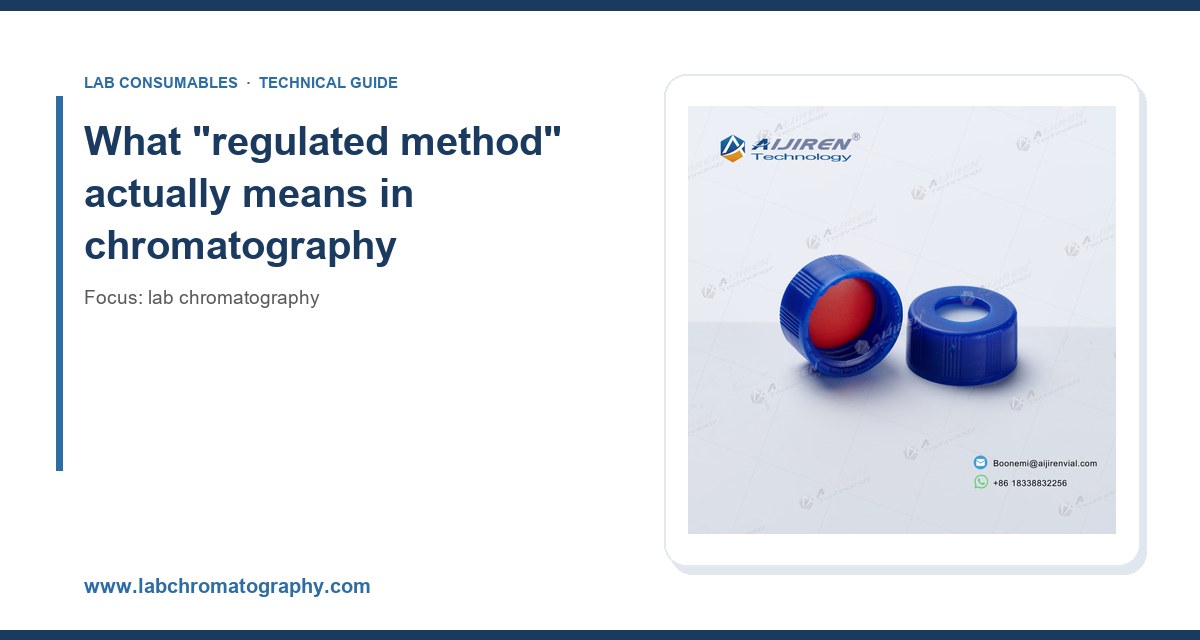
I lost a week of method validation time in 2019 because a 2 mL autosampler vial from a new lot had a septa thickness of 1.3 mm instead of the 1.0 mm I had specified, and the needle on our GC autosampler started coring after about 40 injections instead of the 300-plus we normally got. The method was EPA 8260C, the calibration was drifting, and the audit trail showed nothing wrong with the instrument. The problem was the consumable. That experience is the reason I now treat method compliance as a supply chain problem as much as an analytical chemistry problem.
Regulated chromatography methods (EPA SW-846, ISO, AOAC) lock down the analytical procedure but leave a surprising amount of latitude in the consumables you choose. That latitude is where methods pass or fail. This article walks through what each family of methods actually requires, where the traps are, and how to specify filters, vials, columns, and fittings so the method stays in control from validation through the third year of routine use.
A regulated method is a written procedure with defined performance criteria that a third party will check. The method document is only part of it. The rest is the quality system around it: instrument qualification, analyst training records, reference standard traceability, and the consumables that touch the sample. EPA SW-846 methods, ISO 17025 accreditation, and AOAC Official Methods all share one feature: they define acceptance criteria (calibration linearity, recovery limits, RSD, method detection limit) and leave the analyst to demonstrate that the criteria are met on their specific setup.
That is the crux. The method says “use a 0.45 µm filter” or “use a C18 column of equivalent performance,” and the auditor asks you to prove equivalence. If you cannot, you have a finding. The consumable specification is the evidence.
The three regulatory families you will actually meet
Most chromatography labs I have worked with operate under one or more of these:
- U.S. EPA SW-846 for environmental samples: methods like 8260 (VOCs by GC-MS), 8270 (SVOCs by GC-MS), 8081 (pesticides by GC-ECD), 8310 (PAHs by HPLC), and 300.0/300.1 (anions by ion chromatography). The current SW-846 compendium is published by EPA and updated by method-specific revisions; the authoritative source is the U.S. EPA SW-846 test methods page.
- ISO methods for water, food, and industrial products: ISO 6468 (organochlorine pesticides), ISO 11369 (plant treatment agents by HPLC), ISO 11890-2 (VOC content by GC), ISO 17294 (ICP-MS, not chromatography but often paired). ISO methods are typically more prescriptive about sample preparation than EPA methods.
- AOAC Official Methods for food and agricultural products: AOAC 2007.01 (pesticide residues by LC-MS/MS with QuEChERS), AOAC 994.02 (vitamins by HPLC), AOAC 2011.11 (acrylamide by LC-MS/MS). AOAC methods go through a multi-lab validation and the performance characteristics are published with the method.
Each family has a different attitude toward consumable substitution. EPA methods tend to say “or equivalent” and expect you to document the equivalence. ISO methods often name a specific material and expect you to use it or justify a deviation. AOAC methods are the most prescriptive on sample prep but the most flexible on instrument hardware.
Sample preparation: where compliance is won or lost
In my experience, roughly 70% of method nonconformances in chromatography trace back to sample preparation, not the chromatograph. The instrument is usually the most controlled part of the process. The filtration step, the extraction solvent, and the vial are where variability creeps in.
Filtration: pore size, membrane chemistry, and analyte loss
Filtration is the single most under-specified step in most SOPs I review. The method says “filter through a 0.45 µm membrane” and the analyst grabs whatever is on the shelf. That is a compliance gap and a data quality risk.
Here is what actually matters for regulated work:
- Pore size: 0.45 µm is the standard for HPLC sample prep and is what most EPA and ISO methods specify. For UHPLC with sub-2 µm columns, use 0.22 µm to protect the frit and the column inlet. A 0.45 µm filter will pass particles that bridge a 0.2 µm frit.
- Membrane chemistry: For reversed-phase HPLC with aqueous/organic mobile phases, use PTFE or nylon. PTFE is chemically inert and compatible with nearly every solvent, which is why it is the default for environmental extracts. Nylon adsorbs some basic analytes and is a poor choice for amines. Cellulose acetate is fine for aqueous samples but swells in high-organic solvents. PVDF is a reasonable middle ground for aqueous and mixed phases. For a deeper look at membrane selection, see the technical notes at ptfemembranefilter.com.
- Hold-up volume: A 13 mm syringe filter with a 0.45 µm PTFE membrane has a hold-up volume of roughly 100 to 150 µL. If your autosampler needs 1.5 mL and you filter 2 mL, you are fine. If you filter 1 mL, you may not recover enough for the injection plus the needle wash. Size the filter to the sample volume, not the other way around.
- Analyte adsorption: PTFE is the lowest-adsorption membrane for most small molecules. Nylon and nitrocellulose can lose 5 to 15% of hydrophobic analytes like PAHs and some pesticides. For EPA 8310 (PAH by HPLC), I have seen nylon filters cause a 10% low bias on benzo[a]pyrene. Use PTFE.
- Extractable background: Cheap syringe filters leach UV-active compounds. Run a blank filtration of your mobile phase through the filter lot before you use it in a method. If you see peaks above the method detection limit, reject the lot. This is a documented check in HPLC filter selection guidance and it belongs in your SOP.
One more filtration trap: filter housing material. Polypropylene housings are standard and fine for most work. For trace metals or for methods with a low detection limit for plasticizers (phthalates, adipates), use glass or PTFE-lined housings. I have seen a 20 µg/L phthalate blank come straight out of a polypropylene filter housing.
Vials: septa, crimp, and the puncture count problem
The vial is where I see the most avoidable failures. A 2 mL autosampler vial is a system: glass, septa, cap, and the dimensions that make it fit the autosampler. Get any one wrong and you get coring, evaporation, or a needle crash.
Specifications that matter for regulated methods:
- Glass: Use Type I borosilicate (USP Type I) for pH-sensitive or basic analytes. Type I glass has low alkali leaching. For methods with a pH above 8 or with amine analytes, Type I is not optional. Deactivated glass (silanized) is worth the cost for basic compounds at low concentrations.
- Septa: Silicone is the standard for GC and most HPLC. Silicone/PTFE laminated septa are better for volatile analytes because the PTFE face reduces permeation. Thickness matters: 1.0 mm is the standard for 11 mm crimp and 9 mm screw-thread vials. Thinner septa (0.9 mm) core faster; thicker septa (1.3 mm) can prevent the needle from reaching the sample in short-needle autosamplers. Stick to 1.0 mm unless you have a specific reason.
- Puncture count: A quality silicone septum holds up for 200 to 300 punctures on a 23-gauge needle before coring becomes likely. Pre-slit septa extend this but increase evaporation. For long GC sequences (100+ injections), replace the septum or use a new vial per batch. I change septa every 100 injections on our 8260 sequence and the coring problem went away.
- Crimp vs screw thread: Crimp vials (11 mm) give a more consistent seal and are the traditional choice for EPA methods. Screw-thread vials (9 mm) are easier to use and less prone to inconsistent crimping, but the seal depends on the cap torque. For screw-thread, tighten to hand-tight plus a quarter turn; over-torquing deforms the septum and causes coring. For crimp, use a crimper set to the vial manufacturer’s spec (typically 1.5 to 2.0 mm crimp height) and check it monthly with a gauge.
- Dimensions: The standard 2 mL vial is 12 x 32 mm with a 6 mm neck opening for 11 mm crimp or 9 mm screw caps. Autosampler trays are cut to these dimensions. A “wide-mouth” 9 mm vial is 12 x 32 mm with a 6 mm opening; it fits the same tray. A 12 x 32 mm vial with a 4 mm opening is a different beast and will not fit a standard tray.
For methods that involve COD or other wet-chemistry digestion before chromatography, the vial is a different problem: you need a sealed digestion vial rated for the temperature and pressure of the method. The COD vial specifications (typically 16 mm x 100 mm borosilicate with a PTFE-lined cap, rated to 150 °C) are a useful reference for what “sealed and inert” means in practice.
Solvents and reference standards
Regulated methods specify solvent grade. EPA 8260 requires purge-and-trap grade or equivalent for the purge water and methanol for the standard. ISO methods often specify “analytical grade” but the performance criteria (low blank, no interfering peaks) do the real work. Buy HPLC-grade or better for everything that touches the sample path, and keep a solvent blank in every batch.
Reference standards need traceability. For EPA methods, the standard certificate should state purity, concentration, and expiry, and the standard should be traceable to NIST or a recognized producer. For AOAC methods, the method document specifies the standard source. Keep the certificates in the method file; auditors ask for them.
Instrument configuration: columns, fittings, and the equivalence question
The column is where “or equivalent” gets tested. EPA 8270, for example, specifies a 30 m x 0.25 mm x 0.25 µm 5% phenyl methylpolysiloxane column (DB-5 or equivalent). The equivalence question is: does your column meet the method’s resolution and tailing criteria for the target analytes? For 8270, the method requires a minimum resolution of 0.8 between adjacent peaks and a tailing factor of 2.0 or less for the early-eluting acids. You prove equivalence by running the method’s system suitability standard and documenting the result.
Column selection checklist with numbers
When you are choosing or substituting a column for a regulated method, work through this list:
- Phase: Match the method’s specified phase. 5% phenyl for semivolatiles and pesticides; 100% methyl for volatiles (EPA 8260 uses a 60 m x 0.32 mm x 1.8 µm or 0.25 mm x 1.4 µm column); C18 for most HPLC methods. A C8 or phenyl column is a deviation you must justify.
- Dimensions: Match length, internal diameter, and film thickness to the method. Changing film thickness changes retention and can break the resolution criteria. A 0.25 µm film on a 30 m column is not interchangeable with a 1.0 µm film on the same length for volatile analytes.
- Temperature limits: Check the column’s upper temperature limit against the method’s oven program. A standard 5% phenyl column is rated to 325 to 350 °C. If the method goes to 320 °C, you are near the limit and column bleed will rise. Leave 20 to 30 °C of headroom.
- Bleed: For GC-MS methods (8260, 8270), column bleed shows up as background at high mass. A low-bleed column is worth the extra cost. Run a column blank at the method’s upper temperature before you commit.
- Particle size and pore size (HPLC): For HPLC, match the method’s particle size (5 µm is standard for older methods; 3 µm or sub-2 µm for newer ones). Pore size of 100 to 120 Å is standard for small molecules. A 300 Å column is for proteins and will give different retention for small analytes.
- Endcapping: For basic analytes, a fully endcapped C18 gives better peak shape and lower tailing. Check the tailing factor against the method’s criterion (typically 2.0 or less).
For reference data on column dimensions, phase selectivity, and method-specific recommendations, the technical libraries at Agilent and Restek are the two I use most. Both publish method-specific application notes that give you the system suitability data you need for the equivalence file.
Fittings and connections
A leak at a fitting is a compliance problem because it changes the method’s performance without changing the method document. For GC, use graphite or graphite/Vespel ferrules and tighten to finger-tight plus a quarter turn. Over-tightening crushes the ferrule and creates a leak path. For HPLC, use PEEK fittings and tighten to hand-tight; PEEK is reusable but deforms after several connections, so replace ferrules every few months. Check for leaks with a paper towel and a 5-minute run at the method’s pressure; a wet spot is a leak.
Method validation and the consumable file
When you validate a method, you are validating a system that includes the consumables. The validation report should name the filter lot, the vial lot, the column lot, and the standard lot. If you change any of them later, you need a change control assessment. Most labs do this for columns and forget it for filters and vials. That is a gap an auditor will find.
Here is the minimum consumable documentation I keep in a method file:
- Filter: membrane chemistry, pore size, diameter, lot number, and a blank filtration result showing no interfering peaks above the MDL.
- Vial and septa: glass type, septa material and thickness, cap type, lot number, and the puncture count at which the lot was retired.
- Column: phase, dimensions, lot number, and the system suitability result (resolution, tailing, plate count) that demonstrates equivalence.
- Standards: certificate of analysis, purity, concentration, expiry, and traceability statement.
- Solvents: grade, lot number, and a solvent blank result.
This file is what turns “or equivalent” from an opinion into evidence. It is also what lets you switch suppliers without re-validating, because you can show the new consumable meets the same performance criteria.
Troubleshooting checklist for regulated chromatography
When a regulated method starts failing its acceptance criteria, work through this list in order. In my experience, the first four items catch most problems.
- Check the calibration curve. Is the RSD of replicate injections within the method’s limit (typically 15% for EPA methods, 10% for many ISO methods)? If not, the problem is upstream of the column: injection, sample prep, or standard.
- Check the blank. A blank with peaks above the MDL points to a consumable (filter, vial, solvent, or septa). Run a filtration blank and a vial blank separately.
- Check the septa and vial. Look for coring (a plug of septa in the vial), evaporation (low recovery across a long sequence), or a loose cap (low recovery on the first injection). Replace the lot.
- Check the column. Run the system suitability standard. If resolution or tailing fails, the column is the suspect. Check the inlet frit for particles; a 0.22 µm filter upstream prevents this.
- Check the fittings. A leak at the inlet or the detector changes retention and peak shape. Pressure-test the system.
- Check the method parameters. Confirm the oven program, flow rate, and injection volume match the method document. A typo in the method file is a common cause of “sudden” failures.
- Check the standard. An expired or degraded standard gives low response across all analytes. Prepare a fresh standard and compare.
Comparison: EPA vs ISO vs AOAC on consumable control
The three families differ in how much they constrain your consumable choices. Here is the practical comparison:
- EPA SW-846: Performance-based. Specifies the analytical procedure and acceptance criteria, and allows “or equivalent” consumables if you demonstrate equivalence. Consumable control is your responsibility, documented in the method file. The advantage is flexibility; the disadvantage is that you must build the equivalence evidence yourself.
- ISO methods: More prescriptive on sample preparation and materials. Often names a specific membrane or sorbent. Deviations require a documented justification and, in accredited labs, a method validation. Less flexibility, more certainty about what the auditor expects.
- AOAC Official Methods: Prescriptive on sample prep (QuEChERS kits, sorbents, salts) and flexible on instrument hardware. The method’s published performance data gives you a benchmark for your own validation. You can substitute hardware if your validation meets the published criteria.
My recommendation: build one consumable qualification protocol that satisfies all three. Specify the filter, vial, column, and standard against the method’s performance criteria, run the system suitability standard, and keep the result in the method file. That protocol is your defense in any audit, regardless of which method family you operate under.
Operational precautions that prevent most failures
A few habits have saved me more audit findings than any piece of documentation:
- Qualify every new consumable lot before it enters the method. A 10-injection system suitability run on a new column lot, a blank filtration on a new filter lot, and a septa puncture test on a new vial lot. Thirty minutes per lot.
- Keep a consumable log. Lot number, date received, date qualified, date retired, and the reason for retirement. This is the record an auditor will ask for.
- Torque and crimp to spec. A crimper gauge costs less than a re-run. Check it monthly.
- Replace septa on a schedule, not on failure. Every 100 injections for GC, every 200 for HPLC. Pre-slit septa for short sequences, solid septa for long ones.
- Filter at 0.22 µm for UHPLC, 0.45 µm for HPLC. Match the filter to the column frit, not to the method’s generic language.
- Keep a solvent blank in every batch. It is the cheapest early warning you have.
For sample handling hardware and consumable compatibility data, the Thermo Fisher chromatography and sample handling library is a useful cross-reference, and the broader resource at Lab Chromatography covers the method-specific consumable specifications in more detail.
Takeaway
Regulated chromatography methods are performance contracts, and the consumables are part of the performance. The method document tells you what the result must look like; the filter, vial, septa, column, and standard determine whether you get there. Specify them with numbers (0.22 or 0.45 µm, 1.0 mm septa, 200 to 300 punctures, 325 °C column limit, 1.5 to 2.0 mm crimp height), qualify every lot before it enters the method, and keep the evidence in the method file. That is what turns “or equivalent” into a defensible position and keeps the method in control from validation through the third year of routine use.
References & further reading
Related resources from our lab consumables network:
- Lab Chromatography at labchromatography.com
- Hplc Filter at hplcfilters.com
- Ptfe Membrane Filter at ptfemembranefilter.com
- Cod Vial at codvial.com
External references and standards: