
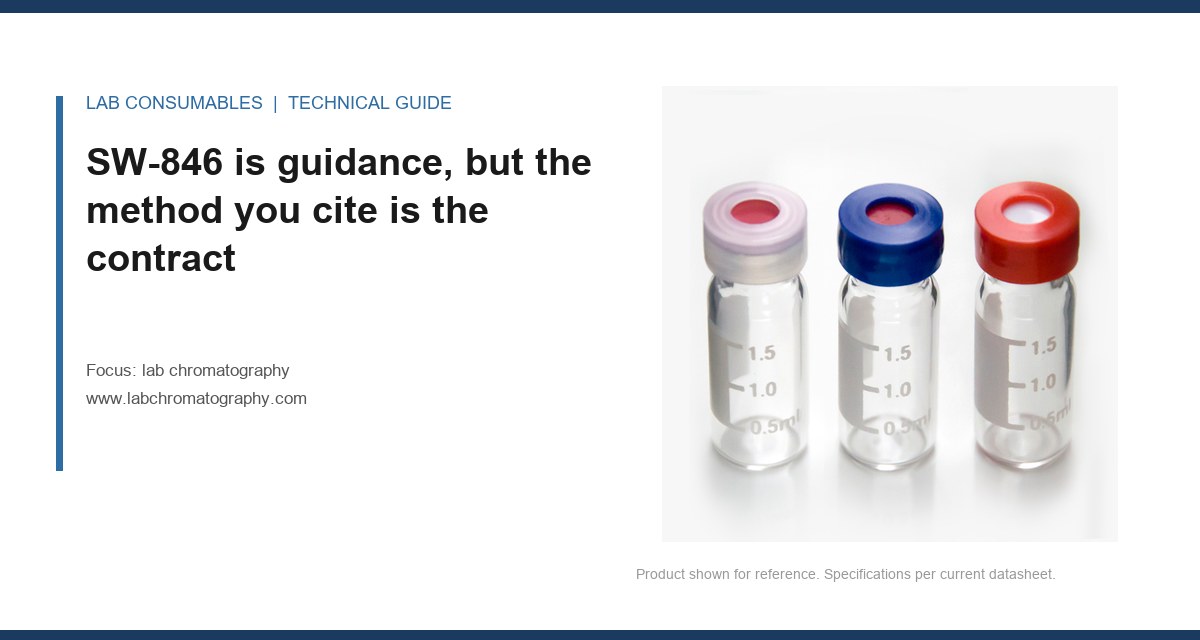
An auditor once pulled a 40 mL VOA vial from our cooler, checked the cap torque by hand, and wrote down the lot number. The septum had been punctured twice, which was within our own procedure, but the vial was filled to the shoulder with zero headspace and the pH check on the log was 11 days old. We had run the sample by EPA 8260 on a purge-and-trap system with a 25 m x 0.20 mm x 1.12 µm column and the calibration had passed at 20% RSD, but none of that mattered. The finding was against sample handling and the paperwork, not the chromatogram. That is the shape of most EPA method findings I have seen in twenty years of running these benches. The instrument rarely fails the audit. The container and the log do. This article is about what EPA method requirements for lab chromatography actually demand at the sample and documentation level, and what an auditor reaches for first when they walk in.
People talk about SW-846 as if it were a single regulation. It is not. SW-846 is the EPA’s Test Methods for Evaluating Solid Waste, and in its current form it is largely performance-based guidance. The methods in it (8260 for volatiles, 8270 for semivolatiles, 8081 for organochlorine pesticides, 8015 for petroleum hydrocarbons, 7470/7471 for mercury) describe acceptable procedures, but the method text itself says other approaches are allowed if you demonstrate equivalency. That flexibility is real and it is also a trap. When an auditor asks “what method did you run,” the answer sets the requirements. If you cite 8270E, you are held to 8270E. If you cite a modified version, your standard operating procedure has to document the modification and the equivalency data, and the SOP becomes the document they audit against.
The practical consequence: your SOP is not a summary of the method. It is the binding specification. Every container type, every preservation limit, every holding time, every calibration acceptance criterion in that SOP has to trace back to either the method text or a documented modification. I have watched labs get cited for holding times that were stricter than the method, because the SOP said 7 days and the log showed 8. The method allowed 14. It did not matter. The SOP was the contract.
What the method says about containers, and where labs drift
SW-846 Chapter Three, “Inorganic Analytes,” and Chapter Four, “Organic Analytes,” are the sections auditors actually read. For volatiles by 8260, the container is a 40 mL (or 60 mL) glass VOA vial with a PTFE-faced silicone septum cap, filled with zero headspace, preserved to pH under 2 with HCl, stored at 4°C ± 2°C, and analyzed within 14 days. For semivolatiles by 8270, amber glass 1 L bottles with PTFE-lined caps, preserved with HCl or H2SO4 to pH under 2, 4°C ± 2°C, 14 days to extraction and 40 days from extraction to analysis. For metals, the container is typically HDPE or PP with nitric acid preservation to pH under 2, and the holding time is 180 days for most metals, 28 days for mercury.
The drift happens in three places. First, headspace. A VOA vial filled to the shoulder but not the meniscus has a bubble. I have seen a 40 mL vial with a 3 mm bubble lose 15 to 20% of its benzene response on reanalysis because the headspace partitioned the analyte out of the aqueous phase. The method says zero headspace. Zero means the meniscus is convex against the septum. Second, preservation verification. The method requires pH check, and the check has to be documented with a date, an analyst, and a result. A pH strip reading “under 2” with no date is a finding. Third, temperature. The 4°C ± 2°C window is a range, not a target. A cooler that reads 1°C on the thermometer but 6°C on the data logger probe at the back is out of compliance, and the data logger is the record that counts.
The paperwork an auditor asks for first, in order
I have been through enough of these to know the sequence. The auditor does not start with the chromatograms. They start with the sample receipt log, because it is the first place a container problem shows up. Then they work forward. Here is the order I prepare for, and the specific document at each step.
- Chain of custody and sample receipt log. Temperature on receipt, preservation check, container type, number of containers, and any discrepancy noted and resolved in writing. If a cooler arrived at 9°C, there should be a corrective action entry, not a blank field.
- Holding time tracking. Receipt date, extraction date, analysis date, and the method limit for each. The auditor computes the interval themselves. A spreadsheet that auto-flags is fine; a handwritten log with a missing date is not.
- Calibration records. Initial calibration curve with the number of points (8260 requires a minimum of five), the response factor RSD or the correlation coefficient, and the acceptance criteria stated. Continuing calibration verification at the method frequency, with the %D or %drift result and the limit (typically 20% for most analytes).
- Method blank and laboratory control sample. One per batch of 20 or fewer samples. The LCS recovery limits come from the method or your own historical data, and the auditor will ask which. If you use in-house limits, you need the study that generated them.
- Internal standard and surrogate recovery. Area counts and retention time shift for the internal standards, and surrogate recovery against the method limits. For 8260, the internal standard area in the continuing calibration must be within 50 to 200% of the initial calibration area.
- Sample chromatograms and integration. The raw data file, the integration parameters, and any manual integration with a reason and an initials. Manual integration without a justification note is one of the most common data integrity findings.
Notice what is not on that list: the column, the instrument, the detector. The auditor assumes the instrument works because the calibration passed. The audit is about whether the sample that went into the instrument was the sample the method required.
Container and handling specs that show up in findings
This is where the consumable selection meets the compliance requirement, and where I have the strongest opinions. The table below is the working reference I keep for the common SW-846 organic methods. Numbers are from the method text and from the manufacturer certificates I actually hold.
| Method | Container | Preservation | Storage | Holding time |
|---|---|---|---|---|
| 8260 (volatiles) | 40 mL glass VOA vial, PTFE-faced silicone septum | HCl to pH < 2 | 4°C ± 2°C, zero headspace | 14 days |
| 8270 (semivolatiles) | 1 L amber glass, PTFE-lined cap | HCl or H2SO4 to pH < 2 | 4°C ± 2°C | 14 days to extraction, 40 days to analysis |
| 8081 (OC pesticides) | 1 L amber glass, PTFE-lined cap | None required if extracted within 7 days | 4°C ± 2°C | 7 days to extraction, 40 days to analysis |
| 8015 (TPH/gro) | 40 mL VOA vial (GRO) or 1 L amber (DRO) | HCl to pH < 2 (GRO) | 4°C ± 2°C | 14 days (GRO), 14 days to extraction (DRO) |
| 6020/7470 (metals/Hg) | HDPE or PP | HNO3 to pH < 2 | 4°C ± 2°C | 180 days (metals), 28 days (Hg) |
The septum is the part that fails silently. A PTFE-faced silicone septum on a 40 mL vial is good for a finite number of punctures before the silicone core starts to coring and the PTFE face lifts. In my experience, a 9 mm septum on a screw cap holds up to about 5 to 8 punctures before the seal degrades enough to show headspace loss on a reanalysis. The autosampler needle gauge matters here. A 23-gauge needle punches a smaller hole than a 21-gauge, and if your lab re-samples from the same vial for a dilution, you are using up punctures. I have a standing rule: one vial, one puncture, and any reanalysis comes from a fresh vial from the same lot. That costs vials. It saves findings.
The cap torque on a 40 mL VOA vial is a number most labs never write down. I specify hand-tight plus a quarter turn, which on a typical 24 mm screw cap lands around 1.5 to 2.0 inch-pounds. Over-torque deforms the septum and creates a leak path at the cap edge. Under-torque lets the vial breathe during transport. If you are buying septa, ask for the certificate of analysis and check the durometer. A 45 Shore A silicone is softer and seals better at low torque than a 55 Shore A. The PTFE face thickness should be at least 0.005 inch (0.13 mm) to resist coring. This is the kind of spec that belongs on your purchase order, not just in a catalog.
Filters and the part they play in method compliance
Sample prep filtration is a quiet source of method findings. If your SOP calls for filtration before injection, the filter material has to be documented and it has to be shown not to adsorb the analytes. A HPLC filter with a regenerated cellulose membrane is fine for aqueous samples, but a nylon membrane will bind semivolatiles and give you low recoveries on the LCS that you then have to investigate. For organic extracts, a PTFE membrane filter at 0.45 µm is the default because it is chemically inert and does not leach. I have seen a lab get a method blank hit for phthalates because they used a cellulose acetate syringe filter from a lot that had been stored next to a plasticizer source. The blank flagged it, we traced it to the filter lot, and we switched to PTFE with a lot-specific certificate.
If you run COD by the colorimetric method alongside your chromatography work, the COD vial handling has its own preservation and holding time rules, and auditors will cross-check that the same sample receipt log covers both benches. The point is that the container and prep consumable is part of the method, not an afterthought. The full range of what a compliant bench needs sits under lab chromatography consumables, and the selection criteria are the same as the compliance criteria.
Two field cases where the measurement found the problem
Case one: the internal standard drift that was a cap problem. A lab running 8260 on a purge-and-trap system started seeing the internal standard area drop to 45% of the initial calibration area on the last four samples of every batch. The %RSD on the calibration was 8%, well inside the 20% limit, so the instrument was not the suspect. The continuing calibration verification passed. We pulled the sample receipt log and saw that the four failing samples were all from one cooler that had been packed with the vials lying on their side. The cap torque on those vials measured 0.8 inch-pounds on a torque gauge, against a target of 1.5 to 2.0. The vials had been hand-tightened by a technician who was new and had been trained on a different cap style. The fix was a torque wrench at the packing station and a training sign-off. The internal standard area came back to 92 to 105% on the next batch. The chromatogram told us there was a problem; the torque gauge told us what it was.
Case two: the LCS recovery that was a filter lot. A semivolatiles bench running 8270 saw LCS recoveries for 2,4-dinitrophenol drop to 38% against a lower limit of 50%. The calibration was clean, the surrogates were within limits, and the method blank was clean. The pattern was that only the phenolic analytes were low, and only on the batches where the extracts had been filtered through a new lot of syringe filters. We ran a spike through a filter from the old lot and a filter from the new lot. The new lot lost 55% of the dinitrophenol and 30% of the pentachlorophenol. The filter membrane had changed from PTFE to a nylon blend without a change notice. The fix was a lot-specific certificate requirement on the PO and a filter check in the SOP. That is a consumable specification that is also a method requirement, and it belongs in the audit file.
The auditor’s checklist, and the three items that fail most
I keep a one-page checklist taped inside the sample receipt cabinet. It is not a summary of the method. It is the list of things the auditor will physically pick up and look at. The three that fail most often in my experience are preservation verification, holding time arithmetic, and manual integration justification. All three are paperwork, and all three are fixable before the auditor arrives.
- Preservation verification: pH recorded with date, analyst, and result for every container, not a batch-level “preserved” note. For VOA vials, the check is done on a separate aliquot, because opening the vial to check pH destroys the zero-headspace requirement.
- Holding time arithmetic: receipt to extraction to analysis, computed by the auditor, not by you. Put the dates in the log in a column format that makes the subtraction obvious. A 14-day holding time with a receipt date of the 1st and an analysis date of the 15th is a finding, even if the 15th is a Monday.
- Manual integration: every manual integration has a reason code and an initials, and the reason is specific (“baseline adjusted for co-eluting peak at 8.2 min”), not “peak shape.” The auditor will pull three random manual integrations and ask you to justify each.
The instrument side is easier to defend because the data is in the software. The sample side is harder because it lives in a log, a cooler, and a cap. If you want to run a compliant bench, spend your audit preparation budget on the sample receipt station, not the detector. The detector has a service contract. The receipt station has a technician with a torque wrench and a pH strip, and that is where the findings come from.
The decision rule for consumable selection under EPA methods
When you are choosing a container, a septum, or a filter for a method-governed bench, the decision rule is this: the consumable spec has to be traceable to the method text or to a documented equivalency, and it has to be on the purchase order with a lot-specific certificate. If the method says PTFE-faced silicone septum, you buy PTFE-faced silicone septum and you keep the certificate. If the method says 40 mL vial, you buy 40 mL and you do not substitute 60 mL without a note. The certificate is the document the auditor asks for when they want to know why your LCS recovery was 52% and not 48%. The torque value, the puncture count, the membrane material, and the holding time are all the same kind of number: they are the measurements that turn a consumable into a compliance record. Pick them deliberately, write them into the SOP, and keep the paperwork where the auditor can reach it. The chromatogram will take care of itself.
References & further reading
Related resources from our lab consumables network:
- Lab Chromatography at labchromatography.com
- Hplc Filter at hplcfilters.com
- Ptfe Membrane Filter at ptfemembranefilter.com
- Cod Vial at codvial.com
External references and standards: