
I have spent the better part of two decades running and auditing chromatography labs, and the single biggest source of pain in a regulated method is never the column chemistry. It is the sample prep and consumables upstream of the injector. I have watched a validated EPA 8270 method fail a proficiency test because a batch of syringes had a dead volume 3 microliters larger than the method assumed. I have seen an ISO 17025 audit go sideways over a filter membrane that was not documented as part of the validated procedure. The chemistry is the easy part. The compliance paper trail and the consumable spec sheet are where methods live or die.
This article walks through what actually matters when you run lab chromatography inside a regulated analytical method: EPA SW-846, ISO standards, and AOAC official methods. I will cover how each framework treats consumables, where the failure modes hide, and how to build a consumables specification that survives an audit. I will give you numbers, not slogans.
EPA, ISO, and AOAC are not interchangeable. They govern different things in different ways, and the consumable implications are not the same. If you treat them as one blob you will over-control some parameters and under-control others.
EPA SW-846: prescriptive, method-numbered, performance-based
SW-846 is the U.S. EPA’s Test Methods for Evaluating Solid Waste series. Methods like 8270E (semivolatile organics by GC/MS), 8260D (volatile organics), 8081B (organochlorine pesticides), and 8015C (TPH) are the workhorses. SW-846 is technically “guidance,” but in practice it is the method of record for RCRA compliance and most state programs reference it directly.
The key structural feature is that SW-846 methods are performance-based. They tell you the analytical figure of merit (calibration linearity, method detection limit, precision) and the required QC (blanks, matrix spikes, duplicates, continuing calibration verification), but they leave the consumable selection to you as long as you demonstrate the performance. That sounds liberating. It is actually the trap. Because the method does not specify the filter membrane or the syringe, you must document your choice and prove it does not degrade the result.
Method 8270E, for example, requires a continuing calibration verification (CCV) within ±20% of the true value for most analytes, and ±20% for the internal standards across the run. Those tolerances are tight enough that a filter with residual phthalate or a syringe with a reactive septum will push you out of compliance before you ever suspect the consumable.
ISO: process and competence, not chemistry
ISO/IEC 17025 is the accreditation standard for testing and calibration laboratories. It does not tell you how to run a chromatogram. It tells you that you must have a documented method, validated it, control your consumables, and demonstrate competence. The consumable angle here is traceability and change control. ISO 17025 clause 6.4 (equipment) and 7.1.4 (method selection and verification) mean that swapping a filter brand mid-project without a documented verification is a nonconformity.
ISO method standards in chromatography (ISO 6468 for organochlorine pesticides, ISO 10301 for volatile halocarbons, ISO 11890-2 for VOC content in paints) are more prescriptive than 17025 but still leave consumable specifics to the lab, provided the performance criteria are met. The practical implication: your ISO quality manual must list the consumable part numbers in the method record, and any change requires a re-verification.
AOAC: collaborative-study driven, matrix-specific
AOAC Official Methods of Analysis are validated through collaborative study, which means the method has been run by multiple labs on the same matrices and the performance statistics are published. AOAC methods in chromatography (for example, AOAC 2007.01 for pesticide residues using dispersive SPE, or AOAC 996.06 for fats by GC) often specify the sorbent chemistry and the consumable format because the collaborative study was built around a specific configuration.
If you deviate from the AOAC-specified consumable (say, a different QuEChERS sorbent ratio), you are outside the official method and must demonstrate equivalence. That is a harder sell in an audit than an EPA performance-based deviation.
The consumable categories that actually break methods
In my experience the compliance failures cluster into four consumable categories. Each has a specific failure mode and a specific documentation requirement.
Sample filtration membranes
This is the number one source of silent method failure. A filter that sheds particles, adsorbs analytes, or leaches extractables will corrupt the run without throwing an error. For HPLC and LC-MS work I standardize on PTFE membrane filters, 0.45 µm or 0.22 µm pore, 13 mm or 25 mm diameter, depending on the injection volume and the sample load. PTFE is chemically inert across the pH range and compatible with most organic solvents, which is why it dominates regulated LC methods. You can review the available formats at PTFE membrane filter suppliers, but the spec sheet is where the compliance decision lives.
The failure modes I have personally dealt with:
- Analyte adsorption on the housing. Polypropylene housings can adsorb hydrophobic analytes at low concentrations. For trace work below 10 ppb, use a low-binding housing or pre-rinse with 1 mL of the sample matrix.
- Extractable leaching. Cheap membranes can leach oligomers or mold-release agents that show up as ghost peaks in the 200 to 400 m/z range on GC/MS. Run a filter blank with the same solvent and volume before committing to a lot.
- Pore-size mismatch. A 0.45 µm filter will pass particles that a 0.22 µm column frit will capture, causing backpressure rise. For UHPLC columns with 1.7 µm particles and 0.2 µm frits, use 0.22 µm filtration.
For mobile-phase and solvent filtration, the same logic applies but the volume is larger. A HPLC filter for mobile phase should be 0.45 µm or 0.22 µm, solvent-compatible, and changed on a documented schedule. I change mobile-phase filters every 20 liters of solvent or every 30 days, whichever comes first, and log it.
Autosampler syringes and septa
A 10 µL autosampler syringe is a precision instrument, and the compliance-relevant spec is the accuracy and the dead volume, not the brand. A syringe with a dead volume of 0.5 µL versus 0.2 µL changes the effective injection volume by 3% at a 10 µL injection. That is enough to fail a CCV at ±15%.
Septa are the other hidden variable. A silicone/PTFE septum with a 10 mm diameter and a 3 mm thickness is standard for 2 mL autosampler vials, but the puncture count matters. After 50 to 100 punctures a septum can coring and shed particles into the vial. I replace septa every 50 injections on high-throughput methods and document the change in the run log. For GC inlet septa, the spec is temperature rating: a standard septum is good to 350 °C, but a bleed-optimized septum is needed above 300 °C to keep the baseline flat.
Vials and closures
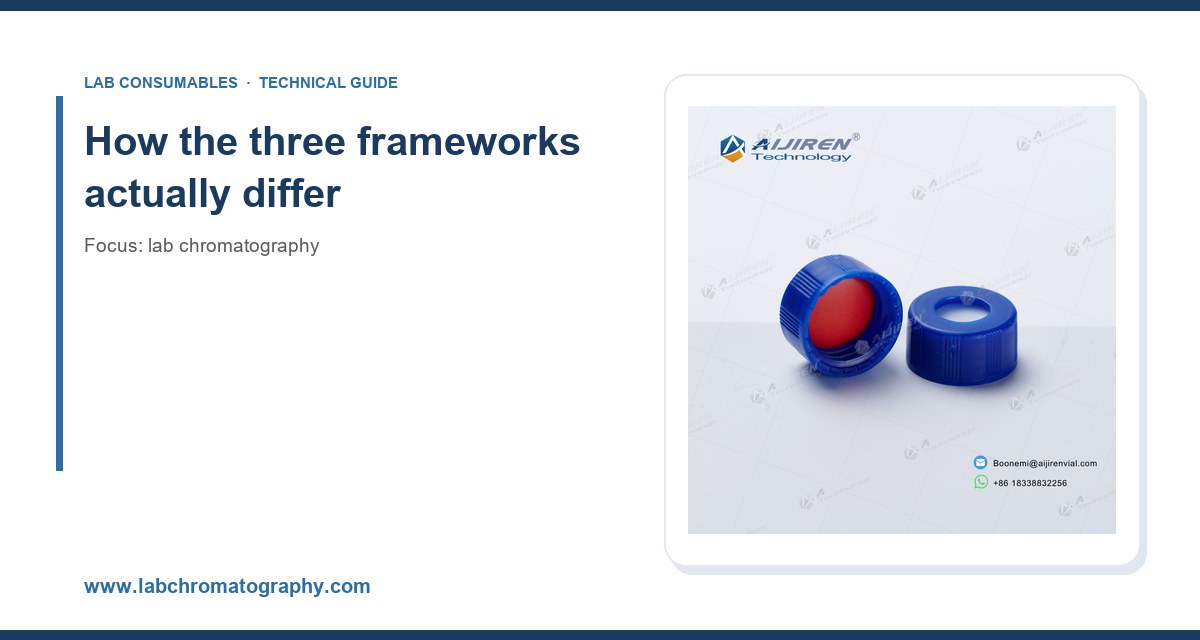
Vial geometry is a compliance parameter because it affects the injection reproducibility. A 2 mL vial with a 12 x 32 mm dimension and a GPI 8-425 thread is the standard for HPLC autosamplers. The GPI (Glass Packaging Institute) thread designation matters: a mismatched closure will not seal, and a poorly sealed vial will lose volatiles and fail the method. For volatile organic methods like EPA 8260D, the vial must be headspace-tight and the septum must be PTFE-faced to prevent analyte adsorption.
For COD and other wet-chemistry methods that feed into chromatography or spectrophotometry, the vial geometry and the closure seal are equally critical. A COD vial with a documented thread and septum spec keeps the sample integrity chain intact from collection to analysis.
Columns and guard cartridges
The column is the most expensive consumable and the one with the most documentation. In a regulated method, the column part number, lot number, dimensions, and particle size are part of the method record. A change from a 150 x 4.6 mm, 5 µm C18 to a 100 x 2.1 mm, 1.8 µm C18 is a method change requiring re-verification.
Guard cartridges are the cheap insurance. A guard cartridge at 2 to 5 µm particle size, matched to the analytical column chemistry, will capture the matrix and extend column life. I budget one guard cartridge per 500 injections on dirty matrices and change it before the backpressure rises more than 10%.
A decision checklist with numbers
Here is the checklist I use when specifying consumables for a regulated method. It is deliberately numeric because “high quality” is not an auditable statement.
- Filter pore size: 0.22 µm for UHPLC and sub-2 µm columns; 0.45 µm for 5 µm HPLC columns. Document the choice in the method.
- Filter diameter: 13 mm for sample volumes under 2 mL; 25 mm for 2 to 10 mL; 47 mm for mobile-phase filtration.
- Filter membrane: PTFE for organic solvents and aggressive matrices; nylon for aqueous; PVDF for protein-containing samples. Never use cellulose acetate with high-organic mobile phases.
- Syringe accuracy: ±1% of nominal volume at the working injection volume; dead volume under 0.3 µL for 10 µL syringes.
- Septum puncture count: replace at 50 injections for high-throughput, 100 for low-throughput. Log the change.
- Vial thread: GPI 8-425 for 2 mL HPLC vials; GPI 13-425 for 4 mL; GPI 15-425 for 8 mL. Match the closure exactly.
- Column temperature rating: verify the column’s upper limit (typically 60 °C for C18, 80 °C for some hybrid phases) against the method’s oven program.
- Guard cartridge: same chemistry as analytical column, 2 to 5 µm particle, changed at 500 injections or 10% backpressure rise.
- Mobile-phase filter: 0.45 µm or 0.22 µm, changed every 20 L or 30 days.
That checklist is the difference between a method that passes audit and one that generates a corrective action. Print it. Tape it to the instrument.
Operational precautions that audits actually check
Auditors do not just read your SOP. They watch you work and they pull records. Here is what they look for in a chromatography lab, and how to be ready.
Consumable traceability
Every consumable that touches a regulated sample must be traceable to a lot number and a receipt date. That means a logbook or a LIMS entry for every filter lot, syringe lot, and column lot. When an auditor asks “show me the filter used on the batch from March 14,” you need to produce the lot number in under two minutes. If you cannot, that is a finding.
Change control
Swapping a consumable brand is a change. Under ISO 17025 and under most EPA quality systems, a change to a consumable that is part of the validated method requires a documented verification. The verification does not have to be a full revalidation. It can be a side-by-side comparison on a representative matrix showing that the performance criteria (recovery, precision, CCV) are met. Document it, sign it, file it.
Blank and carryover monitoring
Run a consumable blank (filter + vial + solvent, no sample) with every batch. If the blank shows peaks above the method’s reporting limit, you have a consumable problem. I have caught three bad filter lots this way in ten years. The blank is cheap. The failed proficiency test is not.
Troubleshooting checklist for regulated runs
When a regulated method fails, work through this list in order. It is ordered by likelihood, not by severity.
- CCV out of tolerance: check the syringe dead volume and the septum puncture count first. Then check the filter lot against the last passing batch.
- Ghost peaks in the blank: filter extractables or vial septum bleed. Run a filter blank and a vial blank separately to isolate.
- Backpressure rise: guard cartridge saturation or filter pore-size mismatch. Check the guard first, then the inline filter.
- Poor peak shape on early-eluting compounds: mobile-phase pH drift or a filter that adsorbed the analyte. Check the mobile-phase filter change date.
- Internal standard response drop: syringe leak or septum coring. Replace the syringe and septum, re-run the CCV.
- Carryover above 0.1%: vial septum adsorption or insufficient rinse. Switch to a PTFE-faced septum and add a rinse step.
For column and instrument-specific troubleshooting, the vendor technical resources are worth bookmarking. Agilent’s GC columns and accessories documentation and Restek’s technical resources both publish application notes that map failure modes to consumable causes. Thermo Fisher’s chromatography and sample handling pages are also useful for cross-referencing consumable part numbers against method requirements.
Building a consumables specification document
The single most useful compliance artifact I have built is a one-page consumables specification per method. It lists, for each consumable, the part number, the critical specification (pore size, thread, temperature rating, puncture count), the acceptance criteria, and the change-control reference. It takes an afternoon to write and it saves weeks of audit pain.
For a method like EPA 8270E, the spec sheet would list the extraction filter (PTFE, 0.45 µm, 25 mm), the autosampler vial (2 mL, GPI 8-425, PTFE/silicone septum), the syringe (10 µL, ±1%, dead volume under 0.3 µL), and the analytical column (30 m x 0.25 mm x 0.25 µm, 5% phenyl methylpolysiloxane). Each line has a lot-tracking requirement and a change-control trigger. That document is what an auditor wants to see.
If you are running multiple methods across a site, standardize the consumable catalog. Fewer part numbers means fewer lots to track, fewer change-control events, and fewer training gaps. The Lab Chromatography catalog is organized to make that standardization easier, but the discipline is yours to enforce.
Takeaway
Regulated chromatography is a consumables discipline as much as a chemistry discipline. EPA, ISO, and AOAC differ in how prescriptive they are, but all three require you to document what touched the sample and to prove it did not degrade the result. Specify your filters, syringes, septa, vials, and columns with numbers, not adjectives. Track lots. Run blanks. Control changes. The column will do its job if you let it. The consumables are where you earn the audit.
References & further reading
Related resources from our lab consumables network:
- Lab Chromatography at labchromatography.com
- Hplc Filter at hplcfilters.com
- Ptfe Membrane Filter at ptfemembranefilter.com
- Cod Vial at codvial.com
External references and standards: